

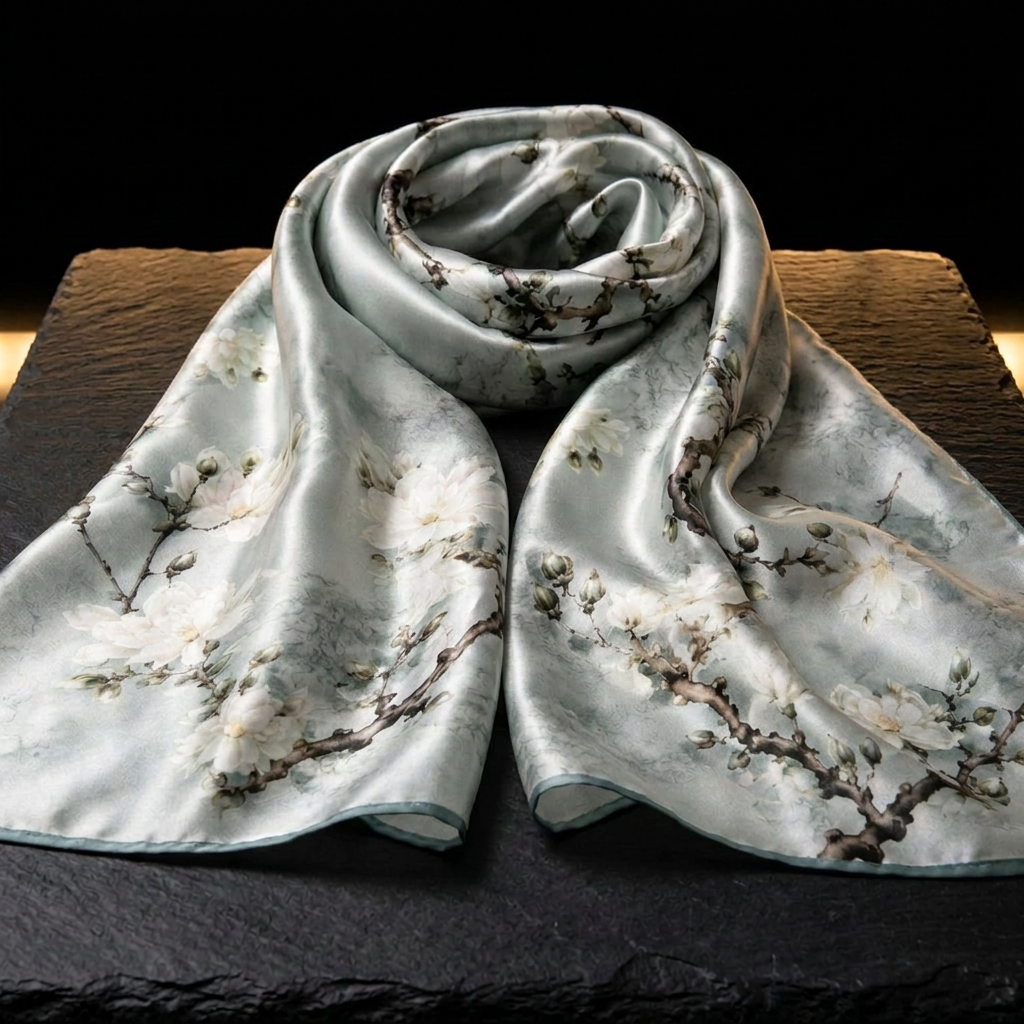
An opera scarf is a long, fine scarf worn for an evening out: a night at the opera, the theatre, a concert or a formal dinner. Traditionally it is white silk worn by men with evening dress, but today women wear long silk and satin opera scarves too. Here is how to wear an opera scarf, which fabrics and lengths work best, and how men and women style it.
How do you wear an opera scarf?
The classic way to wear an opera scarf is the simplest: drape it around the back of the neck and let both ends hang straight down the front, inside or outside an open overcoat. It should look effortless, not tied. A few other ways work well for evening:
- The long drape: both ends hang evenly down the front. Best with an open coat or a dinner jacket.
- The one-side throw: drape it around the neck, then throw one end back over the opposite shoulder. Warmer, and still elegant.
- The loose loop: fold the scarf in half lengthways, put it around your neck and pull the ends through the loop. Neat under a coat collar.
- The shoulder wrap: for women, open the scarf out and wear it across the shoulders like a stole over an evening dress.
Whichever you choose, keep the knot loose or skip it altogether. An opera scarf is about drape and line, so avoid tight wraps that bunch the fabric.
What is an opera scarf?
The term comes from the 19th and early 20th centuries, when gentlemen wore a long white silk scarf, sometimes fringed, over their evening tailcoat or dinner jacket on the way to the opera. It kept the wind off the collar and kept the white shirt front clean under the overcoat, while adding a smart, bright line to a dark outfit. Today "opera scarf" describes any long, fine scarf in silk or a silky fabric worn for evening occasions.
Opera scarf for men: how to wear one
A men's opera scarf is traditionally white or ivory, worn with a dark overcoat over black tie or a dark suit. Drape it around the neck with both ends hanging inside the open coat, or let the ends fall outside the lapels for a more relaxed look. Keep the rest of the outfit simple: dark coat, white shirt, black shoes. In winter, a men's wool scarf is the practical choice for the walk to the venue, with the silk scarf kept for the evening itself. See our guide to choosing and wearing men's wool scarves for colder nights.
Opera scarf for women: how to style it
For women, a long silk scarf is the modern opera scarf. A 55 × 175 cm mulberry silk scarf is long enough for a full drape or a shoulder wrap and light enough to carry in a clutch. Soft neutrals look elegant with black: the Sky Blossom grey and cream mulberry silk scarf sits well with a black dress or a camel coat, while the Golden Bloom cream and gold silk scarf adds a warm gold note for a gala or Christmas concert.
If the venue is cool, wear a black pashmina shawl across the shoulders instead; it is wide enough to cover bare arms and still looks formal. Our guide to wearing a pashmina shawl shows the main wraps.
What length and fabric should an opera scarf be?
Length matters more than anything. An opera scarf should be long enough for both ends to hang well below the chest when draped, so look for around 170 cm or more. Narrower scarves, around 30 to 55 cm wide, drape best; very wide scarves start to behave like a shawl.
Fabric decides how it hangs. Silk is the traditional choice because it is light, fluid and has a soft sheen under evening lights. Satin, a weave often made from polyester, gives a similar glossy look and is easier to care for. Wool and cashmere are warmer but heavier, so they are better for day.
Which is better, a silk or satin scarf?
Silk is a natural protein fibre known for its softness, light weight and breathability. It needs gentle care, but a good silk scarf lasts for years. Satin is a weave rather than a fibre; most satin scarves are polyester, which gives a smooth, glossy surface at a lower price and is easier to look after. For a true evening opera scarf, silk drapes best. For an occasional wear or a colourful print, a satin scarf is a sensible choice. Our satin scarves for women are 180 × 70 cm, long enough to drape.
Why is silk so expensive?
Silk production is slow and labour-intensive. Mulberry silkworms are raised on mulberry leaves, their cocoons are harvested and the fine threads are reeled by skilled hands before weaving. Supply is limited, and the result is a fabric with a sheen and drape that synthetic fibres imitate but do not quite match. That is why a silk opera scarf costs more than a satin one.
Questions and answers
How do you wear an opera scarf?
Drape it around the back of your neck and let both ends hang down the front, inside or outside an open coat. Keep it untied for the classic look.
What is an opera scarf for men?
Traditionally a long white or ivory silk scarf, sometimes fringed, worn with a dark overcoat over evening dress.
What colour should an opera scarf be?
White or ivory is traditional for men. Women can wear any colour, but cream, grey, black and gold look most formal with evening wear.
Is an opera scarf the same as an opera shawl?
Not quite. An opera scarf is long and fairly narrow; an opera shawl is wider and worn across the shoulders, like a pashmina.
Can you wear an opera scarf in the day?
Yes. A long silk scarf draped over a coat looks smart for daytime too. Choose a print or colour to make it feel less formal.
Shop long silk scarves for evening
Browse our women's silk scarves for long mulberry silk scarves that drape like a classic opera scarf, and our pashmina shawls for evening wraps. Long silk scarves come in a gift box, so they also make an easy present for a theatre lover.
Orders are normally dispatched within 24 hours, with free UK delivery, 60-day free returns and a lifetime manufacturer's warranty.

Leave a comment
All comments are moderated before being published.
This site is protected by hCaptcha and the hCaptcha Privacy Policy and Terms of Service apply.